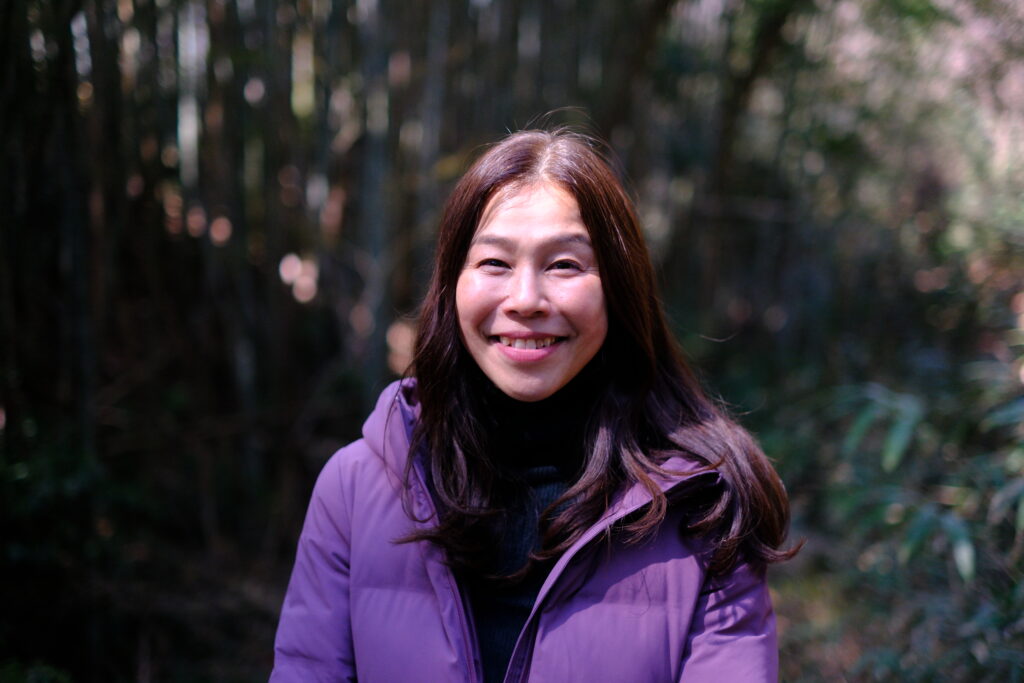
Hiroko Yoda
In Japanese spirituality, in Japanese spiritual culture, the belief, I know it’s kind of shocking, but belief is not really important. It’s basically gratitude, because appreciation is the seed to happiness. You can find happiness from even a tiny thing if you find something that you can thankful for.
Elizabeth Rovere
So welcome, Hiroko. Thank you so much. We are sitting in a shrine in Kumano in the mountains of Japan, and I’m so happy to have you and welcome you to Wonderstruck to talk about the way in which spiritual traditions are embedded in Japanese culture. And you’re a folklorist and a translator, and you’ve just published this beautiful book, “8 Million Ways to Happiness,” which has been a pleasure for myself to read. And everybody on my team has just really loved your book. I mean. Thank you so much. You’re welcome.
Hiroko Yoda
So my book is a mixture of my memoir and Japanese culture, and it’s my personal journey of re-engaging with Japanese spiritual traditions after my mother’s passing.
Elizabeth Rovere
Yes, it was just very beautiful to read, and there was so much in it that felt resonant. I mean, one thing, for example, about just Kumano and the way that it has, or how you describe this kind of radical inclusiveness and that you could pray in any way, you know, that felt authentic or real. You know, you didn’t have to necessarily. I mean, I do appreciate the bowing and the clapping. I think it’s beautiful. But you could do the cross. And apparently you also talked about someone doing a flamenco dance in front of the shrine.
Hiroko Yoda
Yes, that was very fascinating. So before I, you know, go into the deep conversation, I’d like to talk about the big picture. Yaoyorozu no Kami.
Elizabeth Rovere
Yes, yes, yes, yes, yes.
Hiroko Yoda
So it means “8 million spiritual beings” in English. So in times of old, Japanese people thought that everything surrounding them had a spirit. The sun, the moon, rain, trees, rocks. I mean, everything. And so that 8 million here in this concept doesn’t mean the exact number. It simply means infinite or many. So that concept, it’s still pretty much active today. It doesn’t necessarily mean that Japanese people believe that everything has spirit, but we feel the sense of it. So when you mentioned the radical inclusivity that is one of the major characteristics of Japanese spirituality, just because of the 8 million spiritual beings concept is active, because we have so many different, just so many different types of kami here. Even the bad things like poverty or plague or eye diseases or even toothaches. And it doesn’t mean that, again, Japanese people venerate those bad things, but they do exist and they’re all equal in existence because no matter how you wish you, you know, you wish that those bad things don’t exist or disappear, but they are there. We have to… It’s a quiet reminder to deal with them.
Elizabeth Rovere
You know, when you were speaking, it makes me think of like when you talk about how kami or spirits can be in anything, even a toothache. Right. And then immediate, the first reaction is like, well wait, how could that be happiness. But then I realize it’s about what you just said. It’s facing that. It’s like, okay, there is the toothache. And as I accept it and face it, move with it, deal with it, I can then feel presence or happiness or a sense of harmony. So I really appreciate that because I think there’s a way in which globally. Well, I can’t speak for the globe. I’m going to try to speak for the Americans, but we try to avoid, people like to avoid all those kinds of things that are not so pleasant, that are, that are very real.
Hiroko Yoda
Yeah, we, I agree, we live in such a difficult time right now. And another reason why I wanted to write this book in English, but not necessarily mean that, you know, the Japan, Japanese spiritual tradition is, you know, is better than any other cultures. I’m not saying that, it’s far from it, but I just wanted to bring a different perspective. Because I spent almost a decade living in America, I wrote in the book and I learned a lot. America really taught me a lot. Yeah. And one of the things that I learned in America or in the west, is that the people are very flexible in society. But people tend to be very rigid in religion and the Japanese are totally opposite. We are very rigid in society but very flexible in spirituality. And it’s a different perspective.
Elizabeth Rovere
When you talk about the way in which it’s sort of less rigid and the way in which this is traditional or I think about it as found… When I was reading your book, we talk about it traditional or foundational and then how it is Japanese, but how it almost feels very human, right. This foundational way of spirituality or presence being energetic or spiritual presence being present. You know, like, I love how you talk about it can even kami can be, or spirit is in your words, it’s in the piece of paper, my jacket, you know. And I think it’s, so there’s a way that it feels like it’s an enchantment. And in the United States, when you talk about it, how that permeates this world and this culture and how it does to some extent in certain places in the US but that there is more of like I’m this religion, you’re that religion. On the one hand we can chill and hang out, but if we’re talking about being a Christian, it’s like it does feel like it’s more structured or contained.
Hiroko Yoda
Yes.
Elizabeth Rovere
So I do. I think that’s really powerful and profound and that there’s a way in which that it’s so much to offer to have that permeated, embedded sense of spirit and how this spiritual but not religious movement, if you will, I don’t want to not like a political movement, but this way of being seems like it is coming more and more in the US. People are talking about it more. And that’s why I think your book has so much to offer people, for sure, in the US.
Hiroko Yoda
Yeah, I learned that even in America, in the west, even being atheist, it’s a big deal. Big deal.
Elizabeth Rovere
Yeah. It’s like it’s a religion.
Hiroko Yoda
Yes. Or, or changing, you know, the changing from one faith to the other, that’s another huge deal. Well, okay. There are three major belief systems in Japan. Shinto and Buddhism and Shugendo. And the boundaries of those belief systems are very blurred. It’s easy for you to find the Shinto shrine and the Buddhist temple built side by side.
Elizabeth Rovere
Is that what this is? That’s what this.
Hiroko Yoda
This one is different. I’ll get to that. I’ll get to that. That’s one example. And another one is you find Shinto shrine inside, on the property of Buddhist temple. It’s very blurred. This place. This place, I think this building, for example. They call it Shinto shrine but I can feel there’s a Buddhist icons here and there. I mean, when I came here, I learned that the deity was removed, but there used to be Buddhist deity was here. Oh. Yes, so it’s just like that. It’s very, it’s very blurred, intertwined and different type of spiritual beings peacefully coexist here. And also the boundaries between us, the lay people and the spiritual belief systems, are very blurred too. And yeah, so I’m not a religious person, but I go to shrines and temples a lot. It’s that the reason why Japanese people are not “religious” because that the term religion, Shūkyō in Japanese, it was only coined in 19th century. It was a new term. Japan had been closed borders for hundreds of years. And then America came to Japan, Commodore Perry, and a lot of Western concepts came in. Banking, the Constitution, eating of beef, and religion. So, so Japanese made a term as a translation. Made a term Shūkyō as a translation of religion. So the religion right there, it’s basically, it’s Christianity. And then as we know that, so Christian worldview is hierarchy. You know, there’s hierarchy. Absolute God, the single God, on the top, and based on the faith, based on the belief, based on worship. Now, as I said before, our worldview is just basically horizontal view. The worldview, the equal in existence. And there are also, you know, the toothaches and plagues and eye diseases. And so it’s a totally different worldview. So that is why the survey after survey, when Westerners ask Japanese people if you are religious, do you believe in religion? And automatically the answer would be no. I would say no to that too. But if they ask, are you a spiritual person? Do you think spirituality is important in your daily life? And probably a lot of people say yes.
Elizabeth Rovere
A lot of people in Japan would say yes about that.
Hiroko Yoda
Yes. Because I know you told me that this is the first time to visit Japan.
Elizabeth Rovere
Yeah.
Hiroko Yoda
But I probably you noticed that the convenience stores are everywhere.
Elizabeth Rovere
Yes. There’s very good food at the convenience store. That’s true.
Hiroko Yoda
So you, you know, if, you know, if you come to Japan, you know, you would know how ubiquitous they are. But the number of shrines and temples is three times more than convenience stores, and most of them are open to public as long as people behave or show respect. Yeah. So that we. So we are surrounded by the spirituality.
Elizabeth Rovere
When you were growing up, did you, would you have said, I am a spiritual person?
Elizabeth Rovere
Would your parents have said that? Did it. So that came kind of later in this process for you?
Hiroko Yoda
Yes, a lot later, a lot later. Because the spirituality, if you ask me, spirituality, it’s a key to understanding of everything about Japan.
Elizabeth Rovere
So it was around in your life?
Hiroko Yoda
Yes.
Elizabeth Rovere
So you just see it? I didn’t see it, but it’s so curious because I think of it like being embedded. And so I think, like, when did it start? And then I think of your work with anime and folklore, like, it must have started to percolate for you.
Hiroko Yoda
I have been always interested in Japanese tradition, history and culture just because I am Japanese. But also the experience that I spent a year in America as an exchange student at the age of 17, and that open up my eyes. Interesting. Because till then, Japanese culture is just part of my, it’s just part of it’s life, identity. And, and then I never, I. I had never been questioned, of course, because I was surrounded by only Japanese kids. Japanese people. Yeah. So there’s an orientation before all the exchange students got sent to America. Well, yeah, I was an exchange student sponsored by the organization called YFU, Youth For Understanding. And yeah, 50 or 60 kids they sent to America, I think. And. That was brave, to do that. Yeah, it’s a big deal. Now I look back, I think it was just my parents were brave because I was…
Elizabeth Rovere
They let you go.
Hiroko Yoda
Yes. I still remember my parents especially my father was freaked out.
Elizabeth Rovere
Yeah, of course, of course.
Hiroko Yoda
And anyway, so there was an orientation for the getting ready for spending a year in America. And the orientation coordinator gave us a lot of hints, advices, and I don’t remember anything except the, the sheet of paper. And then he says the typical questions Americans would ask.
Elizabeth Rovere
Oh no.
Hiroko Yoda
And then, and then, okay, there’s a list. So there’s the questions and also, you know, answer. Answer. And of course I don’t remember any of it. Except one. Except one that’s like which religion? Which religion do you believe in? And the answer was I’m a Buddhist.
Elizabeth Rovere
That was the answer.
Hiroko Yoda
Everyone got quiet and I was shocked. And one parent raised their hand and excuse me, I don’t know if this is the right answer. And because, yeah, like me for example, I go to Shinto shrine, you know, and I go to temples and take them out or I decorate Christmas tree, you know, for fun. Yeah. Am I Christian? No, I didn’t. So everybody felt uncomfortable. But according to orientation coordinator said yes, I know. But America is a religious country, so it’s easy. This is the easiest way, the easiest answer. And then so that really. So that journey, that was the very beginning. And then I just re-thinking and reflecting. And then.
Elizabeth Rovere
But it was your mom’s passing that really. That was really started.
Hiroko Yoda
Yes, it was massive blow when my mother passed away and I couldn’t do anything.
Elizabeth Rovere
Were you surprised how it impacted you? Like, did you.
Hiroko Yoda
Yes, I was shocked. I was shocked that, of course I was very sad about her, you know, her death. Of course, of course. But also I was shocked how much I identified myself with my mother. It was almost like the, you know, reflection of a mirror. It was just because it’s, it’s understandable because she gave me a life.
Elizabeth Rovere
Yeah.
Hiroko Yoda
Her passing would just basically created a huge void.
Elizabeth Rovere
Yeah.
Hiroko Yoda
And I couldn’t do anything. And then. So I started walking.
Elizabeth Rovere
Yeah, I like how you said that. You’re like, I just put on my shoes and I walked to the park. Like, something just got you out, right? To do that.
Hiroko Yoda
Because that’s the only thing I could do.
Elizabeth Rovere
Yeah.
Hiroko Yoda
But first I just went out and came back and cried. I just couldn’t walk.
Elizabeth Rovere
Yeah.
Hiroko Yoda
But every day, you know, that changed. And then I started, you know, walking a little bit longer. And then I started looking up, looking up front, started paying attention surrounding me. And then. Then I found how kind the nature was. It was fall, and, you know, the color just beautifully changes. Everything has changed. And then also, you know, some tree lost all the leaves. It looked dead, but when I got closer, there were a lot of buds and waiting for, you know, waiting for the bloom in the spring. And that made me realize that the cycle of life. And then realized and taught me that, yes, my mother passed away, but she gave me a life. It was like baton to take and I should live the fullest. And then I realized after that, I was touched on the Japanese spirituality because spiritual beings, kami, are avatars of nature.
Elizabeth Rovere
Yeah.
Hiroko Yoda
They belong to nature. And then that was the deep dive.
Elizabeth Rovere
That’s such a beautiful story about the tree. How did that then take you to the study of the kami?
Hiroko Yoda
So I didn’t know. I had no idea where to start. So I started reading Kojiki, the Chronicle of Japan. Wow. And it’s a collection of myth and legends. This story is about spiritual beings. Everybody knows, but a lot of people never read it. And then. So I. It’s one is that it’s very difficult to read, cryptic basically. And then I started just basically the traveling and then visiting Shinto shrines and temples.
Elizabeth Rovere
How did you find when you visited the shrines or these places, how did you find a way to pray that was, like, felt real for you? Or like, was it like a mantra or what was your experience?
Hiroko Yoda
Yeah. So, okay, here’s the thing. I know that other people, other Japanese who are bilingual, you know, would agree with me, probably would agree with me, that every time we say, here, pray, it’s. It’s off. Okay, it’s off for us because that it’s. It’s. In Japanese spirituality, in Japanese spiritual culture, the belief. I know it’s kind of shocking, but that belief, it’s not really important.
Elizabeth Rovere
Yeah. No, I love that, actually.
Hiroko Yoda
Yeah. It’s respect. Yeah, it’s a respect. It’s basically the gratitude. If you ask me, that is a core of Japanese spirituality, it’s a gratitude for what you have. And the spiritual belief system, like Shinto, for example, is a tool to remind yourself or to evoke the appreciation. Because appreciation is the seed to happiness.
Elizabeth Rovere
Yeah.
Hiroko Yoda
You can find happiness from even a tiny thing if you find there’s something that you can be thankful for. So when I. I always, you know, quote for my book I talked to a Shinto, the shrine, A priest. Shinto priest, yeah. And I asked him what kami are, and he said that kami are a room, a space in your heart, and it is you who fills the space, fill the blank. And he said he loves the concept of 8 million kami, the 8 million spiritual beings, because you can freely choose.
Elizabeth Rovere
It’s enlivening.
Hiroko Yoda
Yes. And because when I look back, you know, for example, my mother’s passing, I mean, later, my, you know, I lost my father too. It was very, you know, it really hit me. But the pain, I’m gonna take it to my grave.
Elizabeth Rovere
Yeah.
Hiroko Yoda
But at the same time, I found the appreciation because they gave me life. So the hardship and basically negativity, you know, the death and impositivities actually can coexist. If you had, if you have, if you happen to find something even tiny, you feel thankful for. Yeah.
Elizabeth Rovere
That makes me think of, like, they fit in the space of your heart. Those two things can fit, and they’re held in that way by your heart.
Hiroko Yoda
Yes.
Elizabeth Rovere
And it makes me think of, like, going back to the thing of prayer, that it’s more of, like the sense of gratitude and respect. Because I had. One of my questions that I wrote down was like, how is Kuyō or gratitude, Right. Transcendent? And you just answered it so beautifully.
Hiroko Yoda
Thank you. Thank you.
Elizabeth Rovere
Yes.
Hiroko Yoda
So there’s no clear division. There’s no clear division. It’s very blurred because it’s all connected. And also, I think the Japanese spirituality is really rooted on something that everyone can agree upon, which is gratitude.
Elizabeth Rovere
And the space of the heart. It’s just fantastic. And the other thing I learned from you in reading your book too, was. And what you just said about belief. And I was like, oh. I was like, oh, like belief, like. And the. You can. I don’t want to. Now I feel like I’m afraid to pronounce anything… Well, the half and half, like.
Hiroko Yoda
Yes.
Elizabeth Rovere
How do you say it?
Hiroko Yoda
Yeah, Hanshin hangi.
Elizabeth Rovere
Yeah, thank you. But it’s like, like, first I was like, well, what is that? That’s like non committal but it’s also like the way in which you could believe in something. Right. It eradicates possibility.
Hiroko Yoda
Yes.
Elizabeth Rovere
And I was like, oh. It was like this realization that that makes so much sense. And then I have to like double down and believe it and I get smaller and smaller and I can have. I can believe in something by virtue of being grateful or by having gratitude. And then it opens instead of closing it down. I was like, that’s so cool.
Hiroko Yoda
Yeah. I’m so happy that you know, that I can give you that. You know, my book provides different perspective and it’s free to take. And then the concept of Hanshin hangi, this half belief and half disbelief. It’s kind of analog meter. You can. You can just adjust it because you know that a lot of stuff are not black and white, cannot be answered in black and white answers. So that concept gives you a third option. Just. It’s okay to have, live in the gray zone. Yeah. When fact comes into play, that thing, you know, that concept is just out of window. A fact is a fact. But the question of spirituality, or maybe the question of Santa Claus. It would be nice that, you know, Santa Claus exists kind of thing. It’s just okay to be vague. Yeah.
Elizabeth Rovere
Well, it keeps the mystery alive because it feels more real, ironically, in a way.
Hiroko Yoda
Yeah. So you mentioned that you watched Totoro.
Elizabeth Rovere
Yeah, Totoro and Spirited Away. Right.
Hiroko Yoda
Totoro is. It’s not a great example. Yes. Totoro is an anime, but when you know the protagonist, you know, the two girls are having a really hard time. Totoro came out from nowhere, you know, in a dark place. And then, you know, the darkness in the nature. But so I. And that’s another thing I learned that in a West, you know, the Western concept that the darkness tends to ties to negative things. Void, emptiness, that kind of thing. Yeah. But in Japanese culture, even darkness is a positive thing. We think that there there may be something out there. Yeah. Like Totoro. Totoro. You know, maybe something that can help us. So it always gives us a positive spin.
Elizabeth Rovere
It makes me think of two things. One is like about, like, you had mentioned something in your book about the paradise of darkness and what can come from darkness and embracing that, like you said with Totoro. Sorry, I know it seems like a big jump, but when you went to the mountains. Well, maybe tell people a little bit about what is Shugendo. And then you went to study with the Yamabushi and as I understand it, you were talking to the waterfall and that, I mean, that seems like it was a very, like another very profound experience.
Hiroko Yoda
Right? But as like I said before, there are three major belief system. The Shinto, Buddhism and Shugendo. The Shinto is native in Japan and Buddhism is a foreign religion. We adapted it many, many years ago, since 6th century. Shugendo is native Japan too. It’s a hybrid of Shinto, Buddhism and other belief systems like Daoism. And they’re a practice centering around mountains. The Shugendo practitioners are called Yamabushi and which means, literally means surrender of mountains.
Elizabeth Rovere
Yeah, it’s cool.
Hiroko Yoda
And so I was curious. I was curious, you know, what Shugendo was about. I’m still curious. I still am learning right now too. Because Shugendo is very interesting to me. Just because I love mountains.
Elizabeth Rovere
Yeah.
Hiroko Yoda
That’s a huge reason why. But also, it depends on who you’re talking to, which region you go to, which history you’re talking about. It’s a totally different thing. Yet in the waterfall was actually Shinto.
Elizabeth Rovere
Oh, okay.
Hiroko Yoda
Yeah, it’s a Shinto shrine. But it’s okay because that’s Japanese spirituality. The boundaries are very blurred. But the waterfall I wrote in the book was a Shinto shrine but venerating a waterfall. It’s called Nachi Falls. There’s a big fall, 133 meters high. So it’s a huge drop. And so there is the Shimenawa rope on the top. You can see it from the, you know, from the bottom. Because that’s the place where you can. You can show respect. And so the first time I went there, many years ago, 10 years ago, I saw the Shimenawa rope. Shimenawa rope is a Shinto icon. It’s basically the area is worthy of respect. It’s a rope, woven rope made with straw. And then has the paper, the Washi paper, folded paper just like this, just like that, attached to it. I saw it and how on earth. I mean, of course I know a Shinto priest would do it. But how did they put up the Shimenawa rope on the top of it?
Elizabeth Rovere
Yeah, how.
Hiroko Yoda
Yeah. And then I was lucky. A friend of mine had a close connection to the Shinto shrine. So he negotiated for me to see the Shimenawa changing rituals, which are held twice a year, every year. And that’s how I ended up. And we hiked in the mountains. And then. Yeah. I learned that the Shinto priest, four or five at the Shinto priest standing very edge up the waterfall, I mean if you go a few steps more, you go bye bye. Yeah, but just sit there and then change the rope. So I asked him if, you know, if they feel scary, are you scared? And then one of the priests, he says not at all. And he said, grateful. That’s very something.
Elizabeth Rovere
Yeah. It also just feels like when you said he said he wasn’t scared, almost like something that just felt so familiar or level of comfort or maybe it’s part of the just having had the experience. I don’t know. I just feel like. I think of like the harmonious aspect of it too. Like just sort of knowing and being attuned so that you wouldn’t fall.
Hiroko Yoda
Yeah.
Elizabeth Rovere
It’s just interesting.
Hiroko Yoda
But I mean, unfortunately not just not anybody, you know, everyone can go, of course, but. But still. But it’s still that, you know, but that kind of appreciation of nature, the powerful thing, you know, you can do that anywhere. And in my book I made the comparison between the Nachi Falls and Niagara Falls. When I went to the Nachi Falls for the first time, I stared at it for an hour. Just stared at it because I was totally moved. It just moved by the power of nature. But that feeling, it’s basically the same I felt when I saw Niagara Falls when I was 17 years old. But Nachi Falls has a Shinto, you know, the Torii Gate. And it has, you know, it has a, it’s a Shinto shrine area. The other one is a tourist spot. Okay. One is holy and not that, you know, that just not. That’s not, you know…
Elizabeth Rovere
I mean, as you’re talking, I’m thinking about. It’s like a. Like Niagara Falls. You still feel the spirit of the water, even though there’s not a gate that you have to pass through. So are you saying like by putting up like. Or having the Shinto, the gate or the creation of that or the Japanese spirituality is like a recognition of it? It’s there.
Hiroko Yoda
Yes. Anyway, it’s there, right. Okay. Non Westerners, a lot of tourists, tourists from abroad ask questions and. Okay. You venerate waterfall. Okay. So are you. Do you just for the waterfall or you know, or just water or what do exactly pray to. It’s not just the water. It’s not, it’s not limited to that because when you started looking at it, that water comes from the mountainside. Okay. You know, it rained. You know, there’s a tree to filter through. That’s why there’s in the beautiful water, you know, and you started seeing that. You know, you can feel unknowable connection. And also there’s something big, something great, and that evokes you the gratitude, because you are, you know, a human being as a part of nature and not nourishing a sense of belongingness, but.
Elizabeth Rovere
Well, you’re talking about that and it’s an experience and a recognition and appreciation. Or as you were saying, gratitude and a feeling of humility and being a part of something bigger, which that feels like it’s such a most meaningful point that we all. Humans. We all need.
Hiroko Yoda
Yes. And I think that’s where it comes down to. I can talk about only just Japan things, but the core, yeah, it’s not really Japan thing. It just. It’s universal.
Elizabeth Rovere
It’s universal. Exactly. I mean, I think that’s why your book has such an incredible appeal, because you read it and you might apply what you’re saying about Japan to something about your own experience or your. Something that feels like kind of very universal, that’s very impactful in that way. The other thing, too, we didn’t really touch upon it as much, but the way in which the natural world is so incredibly prominent and connected and people really have a deep appreciation for nature in a way that I think is much more prominent here or powerful here than in other places. Do you think that’s true? Like, the seasons.
Hiroko Yoda
Yeah, seasons, definitely. The Japanese, the tradition and the culture are closely ties to seasons.
Elizabeth Rovere
Yeah.
Hiroko Yoda
Kimono, for example. Oh, customary. Customary rules. Most of them are tied into the seasons. Interesting, because we know that, like, okay, there’s a good. The greeting, we call it. We say itadakimasu every time we eat and. Oh, yeah, what is that? Yeah, itadakimasu in English literally means humbly accept. I humbly accept. So grammatically, the subject is missing. You feel the blank. So, okay, so you have, say, I don’t know, banana. Okay. In the morning, whatever. And then. And okay, itadakimasu. You have, you know, I humbly accept banana. Okay, that’s great. But it’s actually. It’s more than that. You know, the banana. Maybe the banana is, you know, bought by your mother. Your mom went to the grocery store, picked the best ones for you or, you know, the somebody. Well, of course, people grew that banana. In order to grew that, you need the sun, you need rain, you need a good soil. I mean, it’s. If you start seeing that, you know, the lens, seeing these things. There’s connection. There’s a wave of connections. It’s banana. But it’s much bigger than that. So. Yes. So that is basically. That’s like examples of, you know, the Japanese. You can find Japanese spirituality, even the words we speak. That’s the great example. So it’s a reminder. Yeah. So it’s basically the Japanese spirituality. It’s hiding in plain sight.
Elizabeth Rovere
There’s two questions I want to make sure that I do ask you. One is about the Itako, and the other is about Masakado. I have to ask you about those two.
Hiroko Yoda
Okay.
Elizabeth Rovere
But the thing that was really fascinating to me about the Itako. Is my pronouncing OK? The shamaness who basically spoke to you or channeled your mom after she passed, and your experience of that, like, how was that for you? I mean, that way. I mean. And so that experience is fascinating to me. And then it makes me think of, like, if we’re, if we do live in this world, and I really think we do, where there is spirit embedded and it’s everywhere, and it’s a world of presence in this way.
Elizabeth Rovere
Like, how is she able to experience that and your experience of it? And then have you had dreams about your mom since then? Or experiences of her presence in a way, or even your dad?
Hiroko Yoda
First I went to meet Itako. Then now today, I think she’s 94 years old.
Elizabeth Rovere
Wow.
Hiroko Yoda
Yeah, but when I met her, she was 90. Only 90. Yeah young, right? And I was curious because, as a folklorist, because the Itako tradition is a dying tradition. She is the last traditional Itako. So when she passes away, that tradition’s gonna just dies with her. Because the Itako is, you know, it’s a shamaness. Totally blind, blind shamaness. So her name is Take Nakamura and Take San. I call her Take San. Not Miss Nakamura just Take San. And she lost her sight when she was very little, and it was very common. So if the child is a girl, she would become Itako counselor. And if the child was a boy and he becomes masseuse. And it was, yeah, to make a living.
Elizabeth Rovere
Yeah.
Hiroko Yoda
And so the. Well, the. But to become Itako, you had to become a disciple of other Itako who was also blind. And that really blew my mind because I. You know, I can see everything. I’m relying on my sight. So the totally blind person teaching something to another blind girl, that’s really hard. And so then there’s a lot of trainings, like waterfall. Go to the, you know, walk into the mountainside. Must be very scary. You can’t see, you know, on the feet, but it’s just everyday, waterfall, that kind of thing. Or you know, memorizing all the chanting. And so the talking to the dead, was just only a part of it. And, but today in the modern era and her, you know, main job, I guess, is talking to the dead spirits. And so I was curious, of course, and then, so I went, you know, so I went there with local who was also a folklorist, and, and then I asked her to talk to my mother. And what I learned from that was that, yeah, so that’s okay. The concept of hanshin hangi comes into play and it’s okay to be a gray zone. And it’s not the question of belief or disbelief or the real or unreal because you cannot answer. So what I learned from meeting her was that it’s, you know, I know, you know, my mother or, you know, my parents are gone, but it’s okay to think maybe they are there somewhere.
Elizabeth Rovere
When she spoke to you, did you feel your mother. Did it feel like your mother?
Hiroko Yoda
No. Okay. It’s her. It’s just more like talking to my grandma. Yeah, it’s a grandma. And then also the professional counselor. I felt like that. But she, but her talking as my mother brought me all the memories that slumbered deep in my mind.
Elizabeth Rovere
Wow.
Hiroko Yoda
And especially in the positive ones.
Elizabeth Rovere
Wow, really? Oh, that’s beautiful.
Hiroko Yoda
Yeah, positive. You know, it’s easy to just remain in your mind. Remember the negative ones. You know what I mean? Because it’s a daughter. It’s a daughter. Not like abusive or anything. It’s just, you know, it’s to be daughter. But there are good stuff.
Elizabeth Rovere
And so something happened in that interaction where it evoked these memories.
Hiroko Yoda
And I truly appreciate that. And then also when she, when the Itako was, you know, was talking, but basically she’s just saying, my “mother” saying, live fully. I am there, always. Live fully. Enjoy your life. And that’s all I care. And of course, you know, it was part of my book too. So I interviewed her. So my first question was, you know, so what’s the, what’s the word of the dead? You know, looks like. Right? Yeah, she just basically laughed.
Elizabeth Rovere
She just laughed.
Hiroko Yoda
Laughed and said, I don’t know. I’m not dead yet. Oh, okay. And some people just go there and then try to kind of, I don’t know, debunk, you know. But if you started, you know, seeing those things in a question of belief or a true or, you know, or lie, or real or unreal, or belief or don’t believe, and you’re not going to get that kind of a healing answer.
Elizabeth Rovere
Right. Well, it seems like whatever she’s channeling or saying is some type of wisdom. She’s channeling wisdom and that’s opening you up to some kind of your past experience or your relationship with your mom. So it’s coming up whether it’s true or not or whatever it is.
Hiroko Yoda
Yes.
Elizabeth Rovere
And that there’s really a meaning to that. Yes, it’s important. So what about this Masakado that seems like a guy that died like a thousand years ago?
Hiroko Yoda
Masakado has the many shrines and rituals and the stone memorials and there are many. There are many. He’s a, yeah, and he’s one of the most popular and I think just most beloved.
Elizabeth Rovere
Beloved.
Hiroko Yoda
Beloved, yes. In Tokyo.
Elizabeth Rovere
You said in your book. You said he has. He has anger for us.
Hiroko Yoda
Yes.
Elizabeth Rovere
So, yeah, I want to. I really wanted to understand more about that.
Hiroko Yoda
So for the details, I’d like to, you know, I wrote in the book and everything, but he was a human being. He was samurai warrior.
Elizabeth Rovere
Yeah.
Hiroko Yoda
Thousands and thousands of years ago.
Elizabeth Rovere
Yeah.
Hiroko Yoda
And he, you know, he sounds, he seems like he was a very charismatic, you know, person. He went basically, he went to head to head with the emperor because emperor was the top, you know. How dare you to go, you know, against the emperor. But he was charismatic person and he organized people and he went to head to head, but he lost the war. He got captured, he got beheaded in Kyoto, right next to the riverbank, right next to Pontocho.
Elizabeth Rovere
Right.
Hiroko Yoda
And today it’s famous for the restaurant in Izakaya. All the tourists go, anyway, he got executed. That’s the history. Yeah, but he’s more famous in terms of the story after that. He wasn’t quite dead. His head was angry. And he said, I would unite my body and I would come back again. And I would come back and I would fight again. His head flew, according to legend. Yeah, he flew and then he landed in a spot in Tokyo. It’s today, it’s just the middle, I mean, center of Tokyo, near the Tokyo station, near the Imperial Palace.
Elizabeth Rovere
Yeah.
Hiroko Yoda
The Tokyo. I mean, the Tokyo. Every time, you know, people try to remove it, something bad happens. Yeah, but his anger, it’s not his anger, it’s not at us. He’s not angry at us. He’s angry for us. That’s my interpretation though. But the anger doesn’t disappear. It’s just there. So we interpret it when bad things happen. It’s like, oh, Masakado, you know, the Sir Masakado is angry. And that is why he, you know, we got the earthquakes or accidents or, that kind of thing. That’s how the people interpreted, you know, like, ah, that was Masakado, he must be angry so we got to do something. And do just rituals, you know, kind of say, oh, please, calm down or appease the souls, kind of thing. But. Yeah, but we love him. It’s just because. Yeah, it’s just anger is part of our life.
Elizabeth Rovere
Yeah. When was it, like a couple years ago or more recent?
Hiroko Yoda
Yeah, a couple years ago.
Elizabeth Rovere
That you were speaking in New York City at the anime conference.
Hiroko Yoda
Anime NYC.
Elizabeth Rovere
And you were going to talk about spirituality and you’re like, no one’s going to come. You had 400 people. It was like 400 people, right? Yeah, it kept coming through.
Hiroko Yoda
Yeah. We had to keep the door open so that the people could hear. There’s just too many to go in just now just at a certain point that it was kind of dangerous. But it was fascinating because all the people are just cosplaying and they’re in different anime. But yes, I’d like to say that the Japanese spirituality is a key to understanding everything people love about craftsmanship, cleanness, you know, the, you know, the anime and even, you know, the pop culture like anime and manga. I mean everything, the words we speak, food. I mean everything. So. Yes. So because it’s Anime NYC, I decided to talk about Japanese spirituality. You can easily find Japanese spirituality in your favorite anime. Even though that they don’t talk about spirituality per se, but you can find spiritual icons everywhere. Like Shinto shrine gate, for example, the Torii gate, the two pillars and then the two bars on the top. If you see that gate, that’s a Shinto shrine.
Elizabeth Rovere
Yeah.
Hiroko Yoda
So that I. Okay. The anime Jik Aksu, the Gundam anime, that setting is far future space colony. Okay. But in that anime there’s still, a Shinto shrine. So Japanese people can’t even imagine not to have a Shinto shrine or holy spot in a far space colony, in the far future. Yeah. And yeah in Totoro, another thing is just did not talk about the spirituality. But helper is everywhere, you know, even, in a dark place or, you know,
Elizabeth Rovere
The helper is everywhere in the dark place.
Hiroko Yoda
Yeah.
Elizabeth Rovere
Like, it makes me think of like the. The guardian angel. Right. It’s like.
Hiroko Yoda
Yeah, it’s the same idea. It’s the same idea, same idea. It just. It’s even monsters.
Elizabeth Rovere
So when you say even monsters, the yokai. Right. So that. Does that mean monster literally or what?
Hiroko Yoda
Yokai are yokai.
Elizabeth Rovere
Oh, okay, okay. There’s no translation.
Hiroko Yoda
My husband and I wrote a book called Yokai attack in 2008. Until we published a book, the yokai had been translated as monster, demon, ghouls, that kind of stuff. But if you translate in English and then the meaning gets lost in translation. And yokai are yokai. So simply put, the yokai are characters on Japanese folklore and then also spirits. Yes, spirits. It’s a characterization of an unexplainable thing or natural phenomena. So like for example, you know, sometimes, you know, we get rain, even the sun comes out. You know, that kind of strange, you know, strange phenomena. But it happens so that, you know that the people in old times just like ah. They call it fox wedding because in Japanese folklore the foxes are the trickster animals. So they are probably having a wedding. And then that is why we have such a kind of strange weather. And that’s yokai phenomena. It’s a characterization of natural phenomena. That’s what yokai is. So, in fact, I, you know, sometimes I break, you know, kids heart. You know, this, you know, when I say yokai are not something that you see, you know, because they want to see.
Elizabeth Rovere
Right.
Hiroko Yoda
But traditional speaking, traditionally, yokai are not things that you see. It’s a characterization of something, phenomenon, or natural phenomena or unexplainable things. I will give you a perfect example. Cookie Monster. I always use a Cookie Monster. If the Cookie Monster is yokai. And I mean, of course the simple answer is that it’s not because it’s a copyrighted character for Sesame Street. But just put that to one side. But if the Cookie Monster is the name a big C and big M. Cookie Monster. I am Cookie Monster, like Hiroku Yoda, okay. And he wouldn’t be a yokai. He’s a Cookie Monster. But if that Cookie Monster we know is a small C cookie, small monster. He could be a yokai. Yeah. Because then maybe he’s a characterization of unexplainable things. Cookie mysteriously disappeared from a jar when you are like in bed, you know. And that’s global. Okay
Hiroko Yoda
Because cookies are everywhere.
Elizabeth Rovere
That’s cool. Yeah, that’s cool. Like in all of the experiences or trainings that you’ve had, what do you. What has been the most kind of meaningful or like mysterious?
Hiroko Yoda
The things I didn’t totally, you know, unexpected was that writing that book ended up another form of healing. Yeah. That’s something that I never expected. And because I wouldn’t lie to you that I cried a lot. I cried a lot every time I sit down a computer because I had to, you know, go through over and over you know, the really difficult times. Like my mother’s funeral, my, you know, my father the kind of very end I had to go through because I had to write. But then, you know, a year and a half later and I started noticing myself that, you know, when you write something, you have to write down every details right. So that reader can picture it. Readers can understand. So through that process, I started finding myself. Yeah putting myself in my mother’s shoe. That’s healing. That’s healing. And of course I respect, you know, my, you know, hurt feeling. That’s a real, you know, when I was young and I got hurt. But when I started putting myself in her shoes or you know, when I put what she said in a quote and then, you know, I thought what she meant was this way. But maybe what she meant was that. That’s healing.
Elizabeth Rovere
It’s huge.
Hiroko Yoda
And that’s. That was that. I think that was one of the biggest and biggest unexpected thing in entire, you know, the entire process. Yeah.
Elizabeth Rovere
No, that’s incredible. That’s really beautiful. That’s such a gift. My last other question that I just. You don’t have to. You could just say it in one sentence. Okay, but what’s your favorite anime? Like, what’s your favorite favorite anime? Yeah.
Hiroko Yoda
Oh, right now I’m watching a Jujutsu Kaisen. Yeah. Okay. I have audiobook too. I recorded myself first. I was, you know, I. I told, no, no, I’m not native. I can’t do this. But people told me like, well, it’s your book. You know, it’s your book. And it’s like, okay, well, yeah, I guess. Yeah, I think I should because it has a lot of Japanese words. But I was very worried that not just, not only, you know, that English is not my native language, you know, the pronunciation, but also it’s very personal and I didn’t want to break down. Okay. And so, you know, all the people are so nice. It’s like, okay, you can’t take your time. Well, yeah, which I did. But also at the same time, I had to work as a pro because, you know, editors are waiting for me. We have a publishing date. So I brought really tiny, cute Gojo, the character from Jujutsu Kaisen, and I put it on in front of it and he was basically, yes, just sitting like this and look up and see my face. Every time I felt can tear, I just looked at him. Oh, Jujutsu Kaisen.
Elizabeth Rovere
That’s my favorite. Oh, that’s great.
Hiroko Yoda
So yeah. Jujutsu Kaisen.
Elizabeth Rovere
Thank you. If you enjoyed this episode and you think think someone else might too, please rate the show and share it with a friend. We’d also love to hear your thoughts. Please follow us and leave us a comment on Instagram @wonderstruckpod and let us know what resonated with you. Wonderstruck is produced by Nastasya Gecim at Striking Wonder Productions with the support from the team at Baillie Newman. Special thanks to Brian O’Kelley, Eliana Eleftheriou and Travis Reece and Josh Wilcox. And remember, stay open to the wonder in your life.