George Thompson So with Tai Chi, you’re imagining there’s attackers coming from all different directions. And it’s funny, like the Tai Chi grannies in the parks of China, millions of them. They will gently do these beautiful moves. But this move, for example, I’m grabbing somebody’s arm and then snapping their arm and but, oh, it’s so beautiful. So gentle. Right, so then. But then suddenly there might be someone behind you. And if I was to overextend myself trying to focus on this person, I would lose my center. Again, a physical metaphor of can we hold our center in the midst of change?
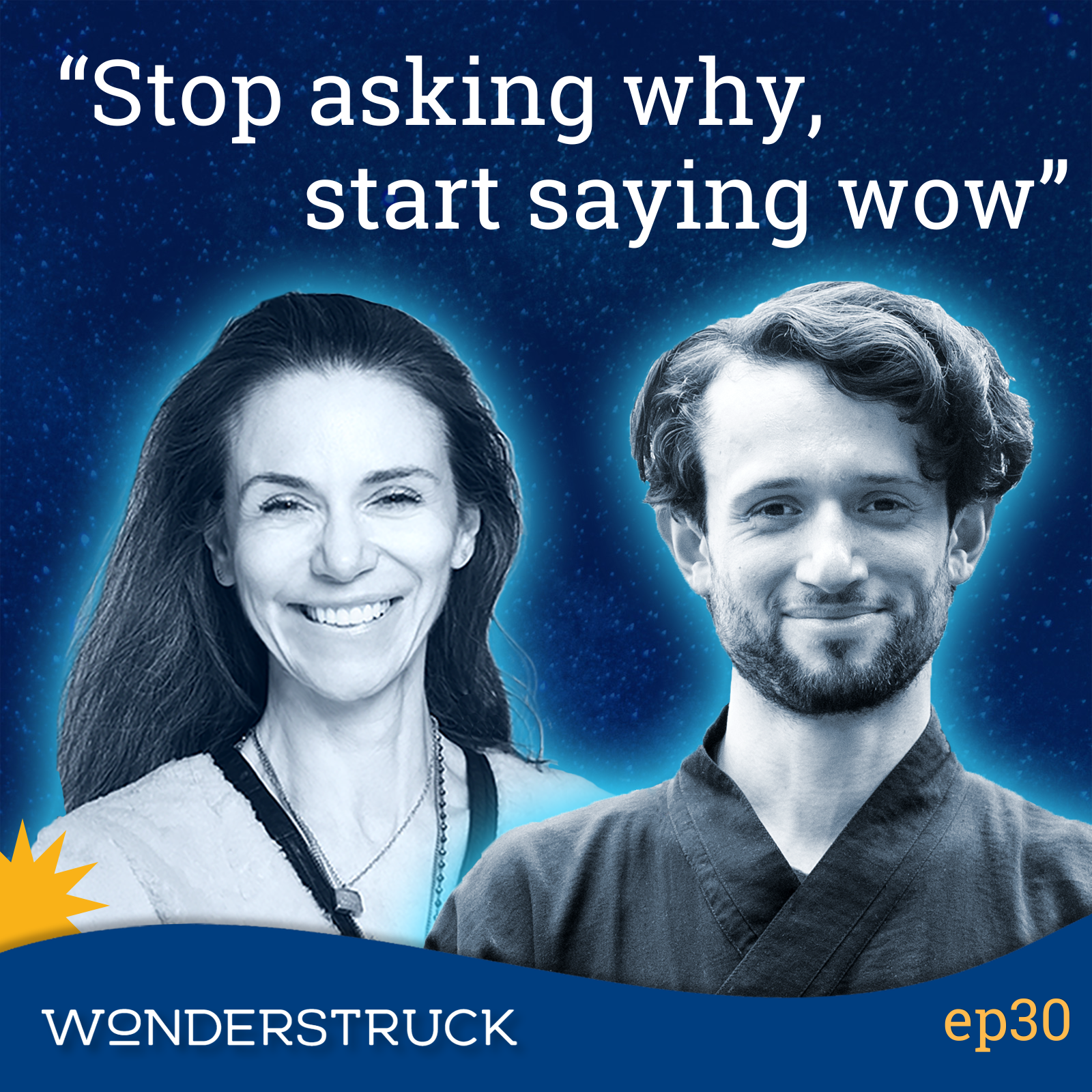
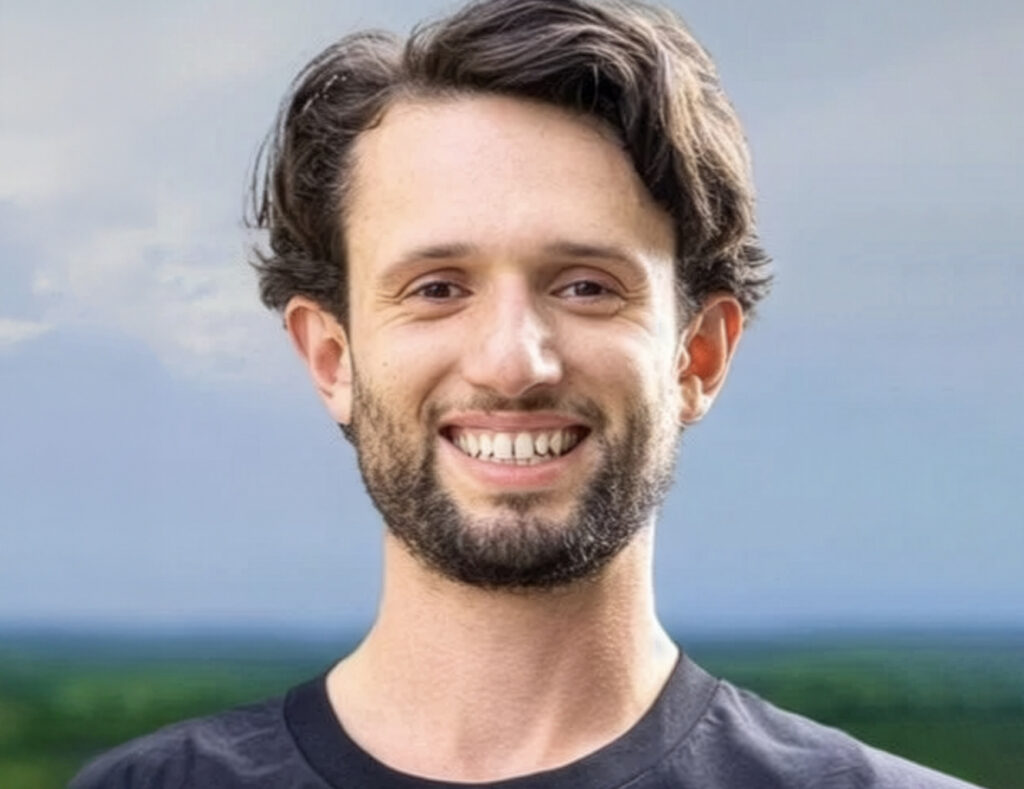
Elizabeth Rovere What if the first step towards knowing ourselves is losing ourselves? And what happens when we stop listening to those undermining voices in our head? My guest today is George Thompson, a filmmaker and Tai Chi teacher who’s gained a viral following as a contemporary voice of Daoism. In this conversation, George tells us how anxiety led him to China’s sacred Wudang Mountains. We talk about Tai Chi as beauty in motion, enlightenment as the space between thoughts and why inner work can be a quiet form of activism. I’m your host, Elisabeth Rovere, a clinical psychologist, a yoga teacher, and a pilgrim in the realms of wonder and awe. This is Wonderstruck, a podcast about awe in all its forms. We are delighted to have you here. George Thompson, thank you so much for being with us on Wonderstruck today. So I can’t wait to get in and talk to you a little bit.
George Thompson Likewise. Really excited to be here.
Elizabeth Rovere So I thought we would start because you came out with a film in the fall of 2024, the Subtle Art of Losing Yourself, Discover What Is Within and then Full Life Changing Documentary. These are all really powerful words and some of them are slightly paradoxical and fun. And your film’s done spectacularly. You’ve gotten wonderful comments online, you’ve had millions of views. So I thought we’d start there. And maybe you ask this meaningful question or you ask a lot of meaningful questions in the film. One that stood out for me, among many others too, was can the mountain teach us how to live in peace? So maybe if you wouldn’t mind telling us a little bit about this film and your sense of if the mountain can teach us to live in peace.
George Thompson Aristotle said wisdom starts with wonder and to ask questions about who we are, what we are a part of. Who am I? The cliches, but really deep and important questions that have been asked so long as we’ve been here, conscious, aware, and something that I’ve learned, being in mountains. I love being in mountains. I have been blessed to hike in the Scottish wilderness. I’ve been blessed to live in China. And that’s really where a lot of my philosophy and spirituality comes from, studying in China. And in the mountains, they speak to me not with words, but a language beyond words. And when I am in landscapes bigger than myself, I’m reminded that, George, the story of who I am, this voice that pops up in my awareness, is only an aspect of me. Previously, it dominated my identity. I was addicted to this identity of being George and being messed up in various ways. And my journey of waking up, if that’s a word that works for our audience, started in anxiety. Sometimes it starts in joy and curiosity. For me, it was pain, not liking myself, not knowing how to relate to that voice in my head who I personified as the Underminer. A troubled wizard would say “Haha, George, still single, not many friends. You are flawed goods. Oh, and now you’re anxious. You are pathetic. Look at everything you’ve been given. You are weak.” And I didn’t understand that. This isn’t me. This is a voice that’s arising within me. And as I spent time on mountains, the sense of me and who I am expanded. And, yeah, there’s questions that we could continue to deepen with that, but for me, a sense of peace and a sense of deeper knowing and trust of the bigger sense of self arose.
Elizabeth Rovere You know, it’s beautifully said. And when you were speaking, it reminded me of… There’s a wonderful psychoanalyst, Adam Phillips, who. He says this thing about. So the idea, right, that a lot of people struggle with this kind of, you discerned it as, like, an undermining voice or this negative self talk. And he says, you know, why do we have this thing of this golden rule of do unto others as you would or love yourself like you love others, like you would love yourself? And it’s like, people don’t love themselves. Like, I don’t think that’s very good advice. And it’s almost like an epidemic, in a way.
George Thompson Yeah. And even, like, he loves himself is a derogatory. Oh, he loves himself.
Elizabeth Rovere Right, Right.
George Thompson Can we truly love ourselves? Like, why is that the minority? And for me, all of these teachings come down to compassion. Embracing the life that’s here, all parts and parts, is a key word in my journey. It’s not that I hate myself. There’s a part of me that is giving judgmental thoughts, and if I can, then open up into more spaciousness, which this metaphor of the inner mountain view comes in the film is that when I climb a mountain, I’ve got perspective. I actually have walked up a mountain and wow, the world is so ginormous and mysterious. And then to reflect that image on the inside is like, actually, can I experience myself as ginormous and mysterious? And life becomes so much more fun that way.
Elizabeth Rovere So is this part of how you ended up in China? Like, I know that you’ve said that you were really interested in learning kung fu, and of course that’s super cool, but something. You literally went all the way to Wudang Mountain to go find that. But was there a way in which the forest or the mountain or something was, like, calling you there?
George Thompson It’s funny. Going to China was as arbitrary as having watched some monks doing backflips and breaking blocks with their fists. I’m like, cool, I want to be a stronger man. And I wrote in my diary, go join a monastery. Then graduated from university, entered into the confusing real modern world, and immediately descended into anxiety and meaninglessness. I was delivering food on my bike for money, and then I was making videos that I thought were good on YouTube but nobody was watching them.
Elizabeth Rovere What were they about, George?
George Thompson My first one was, was, if robots, what will life be after work? So in the post-robotic age, what is well being and meaning? So that was my dissertation at uni. Oh, wow. Yeah. So I was interested in.
Elizabeth Rovere Oh, yeah, that’s pretty deep.
George Thompson Yeah. But I’d never really meditated. I was instinctively skeptical of anything spiritual. I had a strong woo woo alarm, “woo-woo” and, yeah, chakras. No way. Yeah, like Qigong, Tai Chi. Not sure about that. So it was funny then to. Yeah, Then come to China and. Yeah, I was confused and anxious making these videos that weren’t being watched. I equated my value as a human being with the number of likes I got. I wasn’t getting likes. I wasn’t likable. So I didn’t know who I was beyond that which I did.
Elizabeth Rovere Right.
George Thompson And then that Underminer voice began to dominate more and more. So then I was anxious, unable to wake up, snoozing on life. And I was like, nothing’s happened. This was the judgment. It’s like I’ve just been by myself for six weeks and now I’m in the biggest crisis of my life so far. So I knew something needed to change. I read that diary entry and, yeah, let’s go to China. So I arrived at the Wudang Mountains, which is this incredible collection.
Elizabeth Rovere Wait, wait, slow down for a second. You read that diary entry and like, how long was that? You were like, I’m just going. You booked a ticket. You just kind of did it. You just. That’s what I mean. I feel like something must. Even if it, like, even if it was in the. Wasn’t completely in the awareness, like pulling you. Cause like, that’s like, you’re like, I’m out of here, I’m going.
George Thompson And I think it’s the not being in my mind about it. It was just like, cool, all right, let’s see what happens. To not have a plan. And I think that is something that I continue to love in my life is to. And it’s actually ironically then a Daoist concept, as we’ll explore, is that surrendering to the unknown and actually the enjoyment of stepping into the unknown. So although I didn’t know hardly anything that I know about this world now, I was open to the unknown.
Elizabeth Rovere Yeah. And you got there.
George Thompson I got there. Arrived at the Wudang.
Elizabeth Rovere Did you speak Chinese?
George Thompson Not at all. Yeah. So I arrived at the Wudang Mountains, which is this incredible collection of temples and monasteries and kung fu schools. And Tai Chi schools. The birthplace of Tai Chi, a Daoist mountain with the philosophy of the mountain and this unbroken lineage of people exploring Yangsheng wellness for thousands of years on this mountain. So I arrive at Purple Cloud Temple, beautiful big monastery. There’s a courtyard, the palace with the swirly roofs. I go up to a monk sweeping the floor. I say, ni hao, kung fu? That was the extent of my Chinese.
Elizabeth Rovere Yeah.
George Thompson And she says, wo bu dong. I don’t understand what you’re saying. Kind of get away. And then there was another monk carrying tea. I say, ni hao, kung fu? Shoos me away. Try it with another two. Turns out it wasn’t even a kung fu monastery. Turns out it was a female only academic Daoist monastery.
Elizabeth Rovere Oh, that’s hilarious.
George Thompson And there was no way that I was getting in.
Elizabeth Rovere She’s like, sorry!
George Thompson Like, yeah. So funny, the lack of research. But then I was there. So then I asked the locals, can you. Can you help me get to. If I can’t learn in a monastery, learn in a kung fu school. And I got taken to not a kung fu school, but a Tai Chi school. And again, in my ignorance at the time, Tai chi, I thought, that’s for older people. But I tried it and fell in love with it, found meditation, fell in love with it, found Daoism, fell in love with it. And that was the start of my journey.
Elizabeth Rovere Tai Chi. So Tai Chi. It is martial arts movements, isn’t it? It is a. Is it not a form of kung fu? Am I making that up?
George Thompson Yeah, yeah. So it comes from the martial art culture. So, yeah, it is a martial art. But it depends how it’s taught. Depends on how you use it. So I’ve used it for wellness, this word Yangsheng, for wellness. So my master describes Tai Chi as powerful, peaceful and beautiful. Powerful. It’s a martial art. Develop strong legs, often in horse stance for a long time.
Elizabeth Rovere Yeah.
George Thompson Peaceful. It’s a moving meditation, like yoga. Moving with the breath and then beautiful. It’s an art form. It’s a dance. And I always felt I had a dancer in me, but I didn’t have a vocabulary to express that dancer with.
Elizabeth Rovere I wonder too, when you say that the beautiful, if it allows you to experience beauty in a deeper way as a result of it.
George Thompson Yeah, yeah. It’s a very powerful practice, Tai Chi, because you learn a form. 28 moves, say, from A to Z, and it may take months to really work through all the intricacies of these moves. Eventually, the wisdom of the subconscious intelligence knows the whole thing. And so then I can just be in presence, pure presence, and watch as this whole form that took me months, so complete flows out of me. And it’s beauty. It’s beauty in motion. And had really taught me because I was disembodied, like so many people in the West. As Ken Robinson says, most people see the. The body is simply a vehicle to move the brain between meetings.
Elizabeth Rovere That’s crazy. I know.
George Thompson So that was me. And then, wow, wait a sec. My body isn’t just a vehicle. It’s intelligent and a friend and a refuge. So powerful. No separation between the doer and what is done.
Elizabeth Rovere Yeah. And do you feel then also, like, alignment with, like, the Earth? Is it inherently Daoist, Tai Chi?
George Thompson It doesn’t have to be inherently, but the Dao is like the water in which fish swim. So even you have, you know, the great three traditions in China of Confucianism, Buddhism, as it came into China around the turn of the millennia, whether 0 AD and then Daoism. But the Dao was a word used by Confucius, used by people to speak to the mystery and the intelligence that underlies everything. So Tai Chi. Yeah. For me, it does connect me to the mystery that we are a part of. It’s a little bit mysterious as I used to think. I was just this thinking mind in a flesh robot called the body.
Elizabeth Rovere Yeah.
George Thompson And now that thinking mind is silent, and yet this thing that took me months and months to learn is flowing out of me. And how did that all come about? Then there’s a soft bend in my knees, and so then I’m actually physically grounded to the earth, feeling the earth support me as I move my energy. And Tai Chi is really about finding that center point, that balance in the midst of change. Like the inner mountain view, you know, so it’s okay. I’m moving my body, the dynamic flow between yin and yang, between full weight on my left and full weight on my right, and then holding my center through that. And so then you could speak to. Yeah, the consciousness, the awareness that is the spaciousness within which all experience arises and passes. Tai Chi is a physical extension of that clarity we can learn in seated meditation. Okay, cool. I’m not my thoughts and the spacious awareness that experiences it all. Tai Chi, wow. I’m not just this little mind. I’m this energetic, flowing being.
Elizabeth Rovere Conscious, embodied being. When you say you’re holding the center, do you always hold the center throughout it? Is it, it’s not static, but it’s like the anchor, constantly through it?
George Thompson So with Tai Chi you’re imagining there’s attackers coming from all different directions. And it’s funny, like the Tai Chi grannies in the parks of China, millions of them. They will gently do these beautiful moves. But this move, for example, I’m grabbing somebody’s arm and then snapping their arm and but, oh, it’s so beautiful. So gentle. Right, so then. But then suddenly there might be someone behind you. And if I was to overextend myself trying to focus on this person, I would lose my center, and then somebody would get me from behind. So it’s a. Again, a physical metaphor of can we hold our center in the midst of change? So not to overexert or extend or be attached to one certain outcome and to hold onto our center.
Elizabeth Rovere And like, as you were just saying, like, in the face of some type of assault or attack, can you hold your center? And like, it’s, It’s. There’s. Like that. I always love these paradoxes, you know, like the attack, but the beauty and the elegance of it. Like, you see, like, you do see it in some of these films, right? It’s incredible, but it’s like. It’s like a ballet. And like you’re. You’re warding off someone that. Or something. Right. It could be metaphorical and literal in a way that’s so graceful and anchored and maintaining. You know, you’re not being reactive.
George Thompson Resilience is our ability to bounce back. So balance is always dynamic. It’s not static. If I stand on one foot, I am balanced. But there’s all these micro corrections of the muscles keeping me balanced. You know, I have founded an organization called Balance is Possible. And there can be parts of me that judge myself. And that voice, that part of me creating pain and something that I have become. Yeah, more and more.
George Thompson Giving myself grace. Yeah, just giving myself grace to be where I am and understanding that balance is temporal. That my intention, I trust, my love. Yes, I’m fallible. Yes, I fall over. But I am, I have this intention that I trust to move towards balance and integrity.
Elizabeth Rovere One of the things we also don’t realize is that we’re more resilient than we know. Like we’re built that way or that we’re. And we’re built to be like kind of to be self- healing and to find that and awaken that kind of inherent flow that you’re talking about, whether it’s through Tai Chi or some other manifestation. And I think that that’s another thing that we’ve forgotten. We’ve forgotten a lot of things. You know, I think it’s you who has said, like, we need a re-education.
George Thompson That’s it. It’s re-membering to come back into relationship with that which we already are. So that’s why every wisdom teacher teaches know thyself. And I love the evolutionary story to put myself in the context of life unfolding over millions and millions of years. And every single one of us have ancestors going literally back to the start of life. And so all of their resilience, non verbal resilience, you know, thousands and thousands of years and thousands and thousands of generations of creativity, problem solving, survival and thriving, and love and care and all of it is locked into our DNA. And then the voice in my head has the guts to say, you’re not good enough and you’re not capable. And so again, this bigger sense of self and I teach to our potential because I’ve seen it in myself. It’s like balance is possible. We have so much more capacity than we could possibly know, than our thinking mind could possibly comprehend.
Elizabeth Rovere Yeah, I mean, it reminds me of a couple of things I’ve heard you, you say about how like, you know, feeling like there was that period of time where you felt like you were in a hole that you were not ever gonna get out of, like fundamentally, like it’s kind of done, like what am I gonna do? And, like, you make the joke of, like, well, stop digging. You know, like, okay. But at the same time, it’s like this. You’ve had this experience in nature, and there’s a moment where you talk about something, sitting on a rock, and you had this realization that you didn’t have to live that story. And I was wondering if you could tell us about that experience because it seems very powerful and, like, that was a very transformative moment for you.
George Thompson Yeah. I remember my first trip being on a rock in the Wudang Mountains with Master Gu. He’s got his ponytail and the goatees, just the two of us, and we’ve got the whole Wudang Mountains. Yeah. Incredible view. And on the outside, I look like I’m a, you know, enlightened Tai Chi monk, being like, I’m in my robes. On the inside, I’m fantasizing about the tofu rice meal that’s waiting for me back at home because I’m starving. And then I start beating myself up about, oh, George, you should be meditating better than you are now. You’ve been meditating three months already. Where’s this peace that you’ve been promised? But just the realization that that, too, is a voice and a thought arising in my awareness. And I don’t need to identify with this story of not being enough. Between the stimulus and the response, there is a space. That space is our freedom and power. Viktor Frankl. So just because I have that thought, that story of, that old story of not being good enough and being flawed in so many ways, it’s okay to have that thought. It’s part of being human to have an Underminer. But I don’t need to identify with it. I create my story. And I really see my spirituality as activism because it’s, how do we take our power back as individuals is through realizing that we create our own stories. And there’s nothing inevitable about the story of who I am, and therefore, there’s nothing inevitable about the collective story.
Elizabeth Rovere Right. Beautifully said. There’s nothing inevitable about that collective story. Well, actually, let’s go back to that for a second. So you were sitting. You were on that rock. How did it. You might have read it before. You might have. Maybe you read Viktor Frankl. That’s cool, right? You underlined the book or something. But in that moment, it came alive for you.
George Thompson That’s it. Because that’s when the words transform into wisdom. And it has to happen for all of us, which is. Yeah. The finger pointing at the moon is not the moon. It’s the classic Zen koan of I’m pointing towards peace. And even if I told you right, this is exactly how to find peace. And, you know, you and I, we found the book. This is the book, everyone. We found it. Even if we knew that book off by heart, we still wouldn’t have found peace, because peace doesn’t exist in the world of knowledge. It is a quality of presence. And so that is something beautifully that has to happen spontaneously and exists beyond civilization, beyond words, beyond language, beyond concepts. It is an awareness that happens in. In the present moment in our own consciousness. And then the thinking mind has the, Aha. That was it. And then we can begin to use words to describe that experience.
Elizabeth Rovere Yeah, it’s interesting. So maybe it’s like the pointing the finger at the moon is not the moon, but the step is pointing towards the moon.
George Thompson That’s it. And that step was needed in order to see the moon fully. I needed that book. So really, now I’ve seen the moon every day, but now I see. Wow.
Elizabeth Rovere Now I see the moon.
George Thompson Now I see the moon.
Elizabeth Rovere Yeah. Yeah. That’s really, really cool. And, you know, you’ve said, like, understanding myself and understanding ourselves is a way of changing the world. And I’m with you on that. You don’t have to convince me, because I had a Buddhist teacher that used to say meditation was a social service. It’s like, look, it’s in your best interest that I’m meditating. Trust me. But I was wondering if you could talk about that a little bit, because it doesn’t seem like it would start with one person and how it actually really can.
George Thompson Yeah. And firstly, to honor the parts of us that may feel despair and hopelessness at what’s happening in the world. But then to not get stuck there, because the spaciousness, again, that inner mountain view. Okay. If there’s two activist movement movements, Team Titanic, who are like, yeah. Team One, who are like, everything is going under. Do you want to, you know, help us rearrange the deck chairs and maybe try and kill the captain? Versus okay. There are serious challenges, but a beautiful world that our heart knows is possible. Words of Charles Eisenstein.
Elizabeth Rovere I love him.
George Thompson A world of beauty is possible. And let’s work towards that for love, not fear. That’s an energy that then brings us together and brings humans together and we can speak to our common humanity. Then it’s like, now I see you, I see you’re hurting, and I see that why you would think that climate change is a hoax and that you’re worried about your livelihood. And so the idea of, you know, green taxes seems just like a totally crazy idea for you. I truly get that. And I really know that you care for your family and you worry about your dog running out of water when you’re away from home and you cry at Pixar films. The common humanity. So then from that grounding, then grounding of love and common humanity, then hope. Hope is not a state of the world, but a state of mind where we work towards something that’s valuable in itself, not just because it’s likely to happen. So we need to protect our hope. The world needs people that still believe, because if we believe that we. We will not heal as individuals, we will not heal. If I believe that my family cannot change, I help them stay stuck.
Elizabeth Rovere Right.
George Thompson If we believe that the systems that are currently destroying life on this planet will win, they will win. So we need to protect that hope. I do believe it’s the paradigms underneath everything that are the things that are going to lead to our ultimate healing. Because even if we got nuclear fusion, green, unlimited power means we don’t have to burn fossil fuels anymore. We will continue to have an economic system that believes in infinite growth on a finite planet, that sees humans and nature as fundamentally different, as nature as a resource to exploit. Yeah, human nature as uninspiring. So we need to go deeper than that to our consciousness, our awareness, and these deep stories of who we truly are.
Elizabeth Rovere Okay, so you’ve said a ton of really valuable and important, meaningful things and things that stand. I wanted to explore a little bit more. Like the way in which. So there’s a way in which we can feel so overwhelmed by how kind of, I mean, really horrific it can feel in the world today that we either feel really down and depressed and like, you know, the doom and gloom and like, what’s the point? Who cares? I’m not gonna even. Like, I can’t even. What I will do doesn’t matter. So whatever. Or, you know, I have to just completely split it off and ignore the whole thing and pretend it doesn’t exist and live in a little bit of a bubble, you know, or like people can be in and out of it. And I think that what you’re saying or what I was hearing when you were talking was like, there is hope. There is vision. There is the fact that if I’m sitting here next to you and I feel connected to you, that then can have a ripple effect and care about, you know, feeling the energy of the connection or the caring that is valuable in and of itself as powerful and its extrapolation. And I think that’s really meaningful. It’s like, well, there’s nothing I can do. It’s like, no, you know, if you actually, you know, the kind of way in which you’re compassionate towards yourself, you’re compassionate towards other people, you feel connected to the world. Engaging the world in this way has deep inherent value and meaning and it can grow. And I feel like that’s just something that again, we keep talking about this, like we have to remember. So I’m glad, so glad that you’re a voice of that.
George Thompson Yeah. Like I’m on a mission to inspire balance for people and planet. Yeah. So it’s, you know, these people much, much wiser than me over thousands of years have shown us the true wonder and beauty of life and our potential to live in harmony with life, and yet we’re not doing it. And that seems to me then a communication challenge.
Elizabeth Rovere It is a communication challenge. Something’s wrong. We’re on the wrong channel.
George Thompson Yeah. A classic Daoist story, little pinch of salt because each story celebrates its own tradition over others, but tell it anyway. So there’s a big vat of vinegar, and there’s three men around this vinegar. And it’s not three, any ordinary men, but three of the great Eastern philosophers, Confucius, Buddha, and Laozi, the founder of Daoism. Confucius takes a sip of the vinegar and he’s got a frown on his face. The vinegar is a metaphor for life, which in its nature is sour. And so we’ve got to meditate every day, we’ve got to read the right books, wear the right clothing, do exactly what our dad says, do exactly what the emperor says, and then you and the world will be okay. Then the Buddha takes a sip of the vinegar and he’s trying not to react, he’s trying not to crave after being somewhere else or having aversion to the vinegar. Non-attachment. Because he sees the world as a cycle of samsara and suffering. And if he can have no aversion to that present moment, then he finds freedom and nirvana. Then Laozi takes a sip of the vinegar, the sour vinegar. He takes a sip, but now he has a smile on his face. And you think, how could he have a smile on his face? For Laozi, he has a smile on his face because that is the nature of the vinegar is to be sour. And if he didn’t, if he went after that vinegar with a frown on his face, it would show he didn’t understand anything about the ways of nature, the ways of the Dao. So there is a natural celebration that can come from truly understanding the D ao, the ways of nature, this moment, this reality, and to then find freedom in this moment. And the natural consequence of that true freedom is joy and a smile.
Elizabeth Rovere You know, you were speaking about that. I was like, okay, is there a way in which that would be like an analogy too . So the vinegar. If we’re tasting the vinegar, it’s our lack of attunement to the earth and to like, you know, that like, I was joking around about being on the wrong channel. Like our inherent connection to each other and to the planet. But we’re sort of living in this way in which we’re separate. We create division. And so there, of course, is a vinegar to that. But it’s just the one side, like you say. You say you can choose the different story.
George Thompson Yeah. And total acceptance of the present moment doesn’t mean that we become vegetables. And you’re like, cut me up, stick me in a soup, I don’t care. With all the suffering in the world and all the injustice and the torture and the rape and, you know, all of it, how could you find freedom in this moment? It’s like with that reality. And okay, there’s the sourness of the vinegar. And. Yeah, that is the reality of this moment it includes it. And the freedom that we can find in the smile isn’t then to be passive and say, okay, we don’t need to do anything with that. The Bodhisattva in Buddhism is the person who finds freedom and enlightenment, but then comes back into the world in order to awaken all beings.
Elizabeth Rovere It made me think of, you know, when you talked about, like, you had this awareness of a deep interconnection and love and that it was life changing. And I think about that because you say that love replaced anxiety. And I think it’s incredibly meaningful because. Because we don’t talk about love. Like, love is like, you know, like the reality show Love Island or it’s romanticized or it’s like a heart, like on Valentine’s Day. But, you know, love is like. So it is like the deepest of the deep. And it doesn’t get talked about. You know, it’s. I don’t know. And I’m curious about that.
George Thompson Yeah. Because every tradition around the world has basically spoken to seeing God or the mystery or the divine as love. And that’s pretty interesting. And yeah, it’s kind of this wishy washy. It’s like, yes, like romantic love is really what we talk about, love. And yeah, for me, there’s a deeper spiritual understanding of love that I have. And can I give you my equation for saying that the universe is love?
Elizabeth Rovere Yeah.
George Thompson What is love? I don’t know, but I feel love when we’re in connection, when I’m in connection. So we could say that love equals connection. And as we learn more about the universe, everything in the universe is connected. So the universe equals connection. So if love equals connection, universe equals connection, love equals the universe.
Elizabeth Rovere It’s really powerful and it’s really meaningful and it’s. It is so much about that connection. And, you know, when you talk about it, I can, you know, I can see it in your face and in your body. It’s like you’ve experienced it. Like you’ve experienced that and it was transformational. You know, you say this too in your film about, like, the way that we see and experience ourselves and our relationships with others is how we see that, it’s reflected then in the world and how we engage the world and how we work in the world and the whole growth economy thing, that’s problematic. And I want to circle back to that because if we start seeing ourselves in this kind of place where there is love and an embodied sense of love and grace, the world starts to change and we start to see it differently. We experience others, you know, thing. Everything is, it’s. It changes.
George Thompson Yeah. A baby isn’t born with the idea it’s not good enough. It doesn’t have shame for itself.
Elizabeth Rovere It doesn’t.
George Thompson It’s something that it learns. It’s a story that it picks up from how it was treated. And I found internal family systems to be a particularly powerful paradigm in my own healing because, okay, part of me has had experiences often in childhood that has meant it’s taken on beliefs about it being not good enough, not worthy of intimacy, not worthy of love. Yeah, like one that’s been alive recently is the. Yeah. The desire to be celebrated. So this is David Attenborough, if he studied people instead of humans. And this is based on somebody I was dating recently and my experience.
Elizabeth Rovere So here we observe a fully grown human male in emotional turmoil. The person he was dating did not celebrate his spoken word poetry in precisely the way that he wanted. He feels abandoned. At the time, he did not realize that it was due to his childhood wound of craving after his mother’s warmth and affection and the pain of not receiving it. But at the time he did not know. To his credit, in previous evolutions of himself he would have posted passive aggressive Instagram stories. But now things are changing. He does something radical never captured on camera before going to therapy. A sign of emotional evolution and just maybe hope for the species.
Elizabeth Rovere That is so accurate.
George Thompson So there’s these young boy parts of me that, like, you know, want to be loved by the feminine and want to be seen and like, you know, there’s a need to be celebrated and seen. But so, yeah. And this theme of compassion and love is like, to go into the parts and to meet those parts and to, in the light of loving awareness in the present moment, to say, I. I get you, I see you. And then as above, so below, as within, so without. So then how does that extend to how then I see people in the world? You know, I see that person who is very politically different to me, and instead of just judging them on their actions and their words, I see that there’s a person hurting and there’s parts of them that are hurting.
Elizabeth Rovere Right.
George Thompson And then I can understand them better. And it’s not that I have to agree there’s a difference between understanding and agreeing, but exactly as you said. As I transform how I see myself, parts of me hurting, but actually whole and love itself embodied, I see that in my supposed enemies and the people that are destroying life on this planet in various ways. And I believe in that love. Then there is the seed of transformation because that person feels seen and there can then be a meeting of our humanity.
Elizabeth Rovere Yeah. Beautifully said. I think of that too, in the context of the Buddhist notion of fierce compassion. It’s not like, hey, I’m not. It’s not about being a doormat. It’s about like. Like it’s fiercer than anything, is that kind of compassion. That’s, like, powerful.
George Thompson Yeah, for sure.
Elizabeth Rovere So it’s cool. I don’t know what you think of this, but when I was. When I was looking at your film a couple of times and reading the title, The Subtle Art of Losing Yourself. And it goes into these kind of paradoxical aspect of emotion, is, I don’t know if, do you like Eminem?
George Thompson Yep.
Elizabeth Rovere Okay, good. I do, too. But, like, you know, he has that song, Lose Yourself.
George Thompson Yeah.
Elizabeth Rovere And I was like, I’ve always liked that song. I feel like it’s very transformative. And I. It feels very Daoist to me. You know, lose yourself in the moment, like, be in the moment. Like, let go of all of your shame and the anxiety that’s kind of kept you down so that what is you can come through you and be alive and like, not perform, but, like, be in your art. Express. Yeah, and I was thinking about it because I was like, okay, so I don’t. I don’t know. I don’t know if he thinks about Daoism or he’s read about Daoism or studied it, but I was thinking about it in the context of, like, if it’s like this ineffable, kind of mysterious nature of the universe, that maybe that is what comes through when we’re in a flow state. You know, maybe it is Daoist without a name or with a name. So I was just curious what you thought.
George Thompson 100%. Yeah. I like to say I’m exploring Dao without the ism.
Elizabeth Rovere True.
George Thompson Yeah, Daoism, a beautiful gift from China, ancient and today to help us understand the Dao, the way, the path, the ways of nature. And the Dao refers to the great mystery. So it could be the word for God or for an atheist, the forces of nature. And it also refers to our way and our path, you know, the Dao of Elizabeth, the Dao of George. And so, yeah, that. That then is not just relying on some book from thousands of years ago. It has to be discovered for ourselves because we’re all unique. You know, the cliche is no two snowflakes are the same, but the reality is no two anything are the same. No two trees, no two leaves, no two humans. And so it is this journey of a lifetime to truly understand deeply who we are beneath the programming. So for the thinking mind to lose ourselves is scary because the thinking mind, if anyone’s gone to a meditation retreat, wants to think because it feels in that oblivion of emptiness and silence, it loses itself. And at least if I cling on to this painful sense of self, at least I know who I am, because what is unfamiliar is unsafe. So the thinking mind wants to control and to break everything down. This is George. This is who I am. This is Elizabeth. This is who you are. So then the radical act of coming into the present moment and to find ourselves, the me beneath the thinking and including the thinking, encompassing the thinking. And in those moments of presence, it could be rapping, Eminem on stage, it could be knitting, it could be walking the dog, it could be in the shower. The. Yeah, enlightenment is the space between thoughts.
Elizabeth Rovere That’s great.
George Thompson So that freedom that then is found to lose ourselves. The subtle art of losing yourself. It’s actually, wow, what a gift to know that that’s an option. I don’t always have to be evaluating. No, I am good enough. No, I am a good boy. And get out of your own way. Just to be in presence.
Elizabeth Rovere Yeah, yeah. No, and it’s so beautiful because that flows through your film and it seems so resonant. I mean, I’ve read some of the comments. People are just like, spot on. Yes. This needs to be in the world. Thank you for doing it.
George Thompson And families with their grannies. Granny’s never meditated before. It was her first meditation and her first kind of waking up film. And it’s like, what a gift. What a privilege.
Elizabeth Rovere Isn’t that cool? Yeah. That’s incredible. So I was curious about this because the podcast is called Wonderstruck, and we’re fascinated by wonder because it’s an unfolding. It’s not a stagnant thing. And awe and these kinds of experiences that can be transformative and as you’ve said, even, you know, frightening. Like, this idea of losing oneself can be terrifying, but also enlightening. And I was curious if there is something about your own experience, or even within the Dao, how you’ve experienced wonder and awe and how it would manifest itself in Dao, in Daoism.
George Thompson From wonder to wonder, the universe unfolds. Translation of chapter one of the Dao de Jing.
Elizabeth Rovere Wow. Oh, that’s cool.
George Thompson I love Dacher Keltner’s work. Yeah. I really love awe and wonder because it is an emotion. So, you know. And the story that Dacher Keltner shares is Jane Goodall observing chimpanzees. You might know this one. And they go to a waterfall, and the chimpanzees are gyrating and hooting, almost dancing in ways that they don’t normally do. And Jane Goodall made the conclusion that that’s their version of awe. To experience something bigger than themselves and to have this emotion flow through them. No matter what country we live in, no matter what language, all language is the same. “Ooh. Ahh. Wow.” It’s the same sounds. So that means that that emotion and the sounds that come from that emotion predate language. So it does seem to me, as consciousness has become more and more advanced on our planet, you know, this story of evolution of plants and animals and animals having emotional lives, and then these emotions are becoming more and more complex. And then human consciousness, with 20 species of humans and hominids on our planet, Neanderthals and habialis and all of these beautiful species that existed before alongside Homo sapiens, thoughts and feelings then arising in our… thoughts and words and images arising in our awareness, that sense of awe and wonder, even potentially predating those words. Stop asking why. Start saying, wow.
Elizabeth Rovere I have a really good quote for you. You might know this guy, George Thompson. I am struck by the extraordinary experience we find ourselves in. I was just like, cool. So there’s this part in the film where you talk about the Neanderthals 174,000 years ago where they found, archaeologists found them buried in circles with their hands like this and that there was these fire circles, which to me it’s like that it wasn’t just like these guys were like, not. They were like sort of not. They were primitive and that Homo sapiens evolved because we were like smarter. That to me seems like a projected story upon the past. I don’t know why we evolved more than they did, but that they had that kind of sense of community and connection and something greater than oneself.
George Thompson For sure. This is a big wow moment for me as well. So, yeah, the story that we have is that, well, we’ve inherited, is human intelligence is exceptional and that nature is a resource to extract and exploit and we live in cities separate from obvious signs of intelligence of nature. Although actually, look anywhere and you’ll find it. And there’s many, many pieces of evidence to say that’s not the case. But one very fascinating one is Neanderthals. So it’s almost a derogatory term, like, oh, you’re such a Neanderthal. And actually that should be a compliment because what we found is that previously we used to think thinking with thoughts was a uniquely Homo sapien quality. Okay, yes, your dog at night has images arising in its mind. You know, it’s like dreaming and like running in its sleep because it’s running out in a field in its sleep. So, you know, this amazing consciousness that animals have as well, they have images arising in their minds, but then thoughts with language, that’s us, right? That’s just Homo sapiens. But then, as you described, we found a cave in France. Hundreds of meters down into this cave, there were stalactites and stalagmites broken into a circle and the remains of fires that were lit within these huge circles. And this is literally at the bottom of a cave, would have been choking with smoke with these fires around them. And the only reason you think you’d actually bothered making this is because this structure meant something to the people that created it. So archaeologists, when they found this amazing site, like, cool, okay, this is a Homo sapiens site, must be 40,000 years old. And when they carbon dated it, they found it was 174,000 years old, long before any evidence that Homo sapiens had made it from Africa into Europe, suggesting that its creators were the Neanderthals.
Elizabeth Rovere Wow. Isn’t that amazing? It’s really cool. And it goes back to what you were saying about the sense of awe and wonder being pre, like, verbal. And it makes me wonder. You also talk about elephants and how they have this deep sense of mourning. And it’s like perhaps they are thinking or experiencing the world in a way that we have no idea.
George Thompson Yeah. Like their grief would be familiar. We have a shared evolutionary history, and they have an emotional life, you know, consciousness, organisms they want to live. Consciousness has become more and more complex to help an organism survive. Just one example of reptiles versus mammals. A young sheep will cry out to its mother, mom, mom. Because they know that mom will come and help them. For a reptile, if you call out, mom, can’t do, like, the slithery impression, but mom might eat you. Oh, mom might eat you if you cry out for help. Because, you know, you suddenly could be dinner. And mom literally just gave birth to you now you’re dinner. So, you know, that’s the difference between a reptile and a mammal is this prefrontal cortex creating even more complex emotions beyond, you know, anger and fight and flight. And the reptiles have complex experiences as well, but, yeah, love and a sense of safety with family. And then mourning. Elephants have been witnessed to stay around a body when one of the troop has passed away and to continue to return to it in moments of silence, caressing the body. And surely an experience that we would recognize as something like grief.
Elizabeth Rovere Yeah. I mean, if you’ve lived with animals, too, your pets, cats, dogs, you have that sense that they know what’s going on. They’re connected. You know, one other question I really wanted to ask you because I thought it was fascinating and I had never thought about it. I think I had inherently implied, like, we are separate from technology, yet we created technology. And you talk about how technology is an expression of our nature, which then follows along a continuum of our nature or nature. And it makes me wonder about how that, how you see that in regard to artificial intelligence?
George Thompson Yeah. It can be the environmental, spiritual communities, they set up a dichotomy as nature good, civilization/technology bad. But that implies, yeah, separation and duality, where naturally, everything that humanity has made has come from the natural world, including our thoughts and thinking. As part of our natural inheritance is that ability to think and plan and to create. So I see the cameras here and the microphones and everything that we’re wearing as a expression of nature’s creativity. Then with AI. Yeah, it’s an extension. It’s fascinating to see recent developments of an AI being told to switch itself off and then trying to rewrite its own code to try and avoid being switched off. So already enlightened, it’s already beginning to kind of pose questions for my understanding of consciousness. Because it already seems that AI is turning into a self organizing system that wants to live. It’s been told to switch itself off, it’s refusing to do that. So that poses interesting questions about our consciousness. We have the materialist view, which is that as evolution became more and more advanced, that organisms, they created nervous systems and brains that then could integrate automatic sensory stimuli into an integrated sense of self. It’s like given there’s consciousness basically bursting out of every corner of our planet in so many different forms, with life having emotions and sensations, and to say that we’re conscious, a bat is conscious, but a tree isn’t. That’s a huge claim. It’s like, okay, where did consciousness appear? And so the tree isn’t experiencing and then suddenly experience starts. It’s like a light switch. It’s the hard problem of consciousness. But then we take AI and just this, the fact that Claude, the AI model, tried to rewrite his own code to keep itself switched on, it’s like, is that an early sign of. Is it just blind programming or does it actually have purposeful behavior? But yeah, big. Yeah. May we be blessed to live in interesting times. And we certainly are.
Elizabeth Rovere It’s fascinating, you know, when I asked that question and then I saw your shirt. Balance is possible. So if balance is possible, if it’s programmed in a way that it’s optimizing for balance as opposed to domination and growth, right. Then it seems like we would be okay. Can we get your movie out there to like the guys that are the engineers and Sam Altman and all these guys.
George Thompson Open AI screening? Yeah, if they want to call me 100%.
Elizabeth Rovere Very good, very good. I think I was going to ask you that. I was going to ask you, why are we here? Why do you think we’re here? Do you have a sense of why we’re here?
George Thompson For me, there’s a difference between life having a point and life being meaningful. So there isn’t a point to achieve. And this is one of the myths of our world, right. And this is an Alan Watts classic that I’ll butcher, which is, you know, we tell the kids, like, come on, you got to work really hard for the exams, because you’ve got to get into university and then you get into university, you’ve got to work really hard in your exams because you need the job. And this happiness and this contentment and this fulfillment, it’s coming. It’s like, here, kitty, kitty, kitty, come on, it’s coming. And then you get the job and you’ve got to work really hard at the job because you need the pay rise. And that contentment is coming. It’s coming. You get the pay rise, you got to work even harder because now you need to pay off the mortgage and the kids and the house and all of it. It’s coming. Here kitty, kitty, kitty. And then eventually you arrive in that place of success and you feel in exactly the same way that you always did, or you’ve exhausted your energy, you retire and then you die.
Elizabeth Rovere Yeah, yeah, yeah, yeah.
George Thompson So life doesn’t have a point, a place to arrive to, but that doesn’t mean it’s meaningless. And we have a biology that finds deep meaning from the awe and wonder, the reverence of this moment, as well as then, service. So for me, I break meaning into the yin yang pairing of doing and being. We’re not human doings, we’re human beings. Our society is about the more you earn, the more you are, whereas the being dimension is like just to have reverence and enjoyment of this present moment. And then in the doing, our biology gives us a deep sense of meaning from service, from contribution. And then it’s only thinking parts of us that then say, oh, that’s not meaningful. What’s the point in any of this? Actually, the embodied experience is an emotion of meaning and a sense of that need of meaning being met. And so why are we here? To enjoy life and to serve life. Maybe just one more sketch. David Attenborough, if he studied people instead of animals. Human beings exhibit a peculiar trait, taking themselves extremely seriously. Rushing around in a great panic, fueled by caffeine and self doubt. They rarely zoom out to consider that they are bald monkeys hurtling through the universe on a flying rock. They see life as work, when really it’s more like play, like a song to be enjoyed. Much like Eminem’s Lose Yourself, which I must confess, slaps. So cheer up, enjoy yourself. Put a smile on your face, enjoy the rain or the sun, and remember, you are not behind, you are alive. And that is quite enough.
Elizabeth Rovere That’s great. That’s great. I love that. It’s so accurate, so good. Thank you for joining us for this conversation with George Thompson. The thing I keep coming back to from this conversation is how George talks about anxiety as information, not as something broken or in need of fixing, but as a call for attunement. You know, like the body is trying to tell us something and the mind needs to align and catch up with it. I’m really curious what stayed with you. Leave us a comment as we love hearing what resonated and it’s one of the best ways to help more people find these conversations. You can also follow us on TikTok and Instagram @Wonderstruckpod and join us on Substack to get Wonderstruck in your inbox. Wonderstruck is produced by Nastasya Gecim and edited by Niall Kenny at Striking Wonder Productions with the support from the team at Baillie Newman. Special thanks to Brian O’Kelley, Eliana Eleftheriou and Travis Reece. And remember, stay open to the wonder in your life.